Is It Better to Rent or Buy in the Current DFW Market?
Updated: September 2026
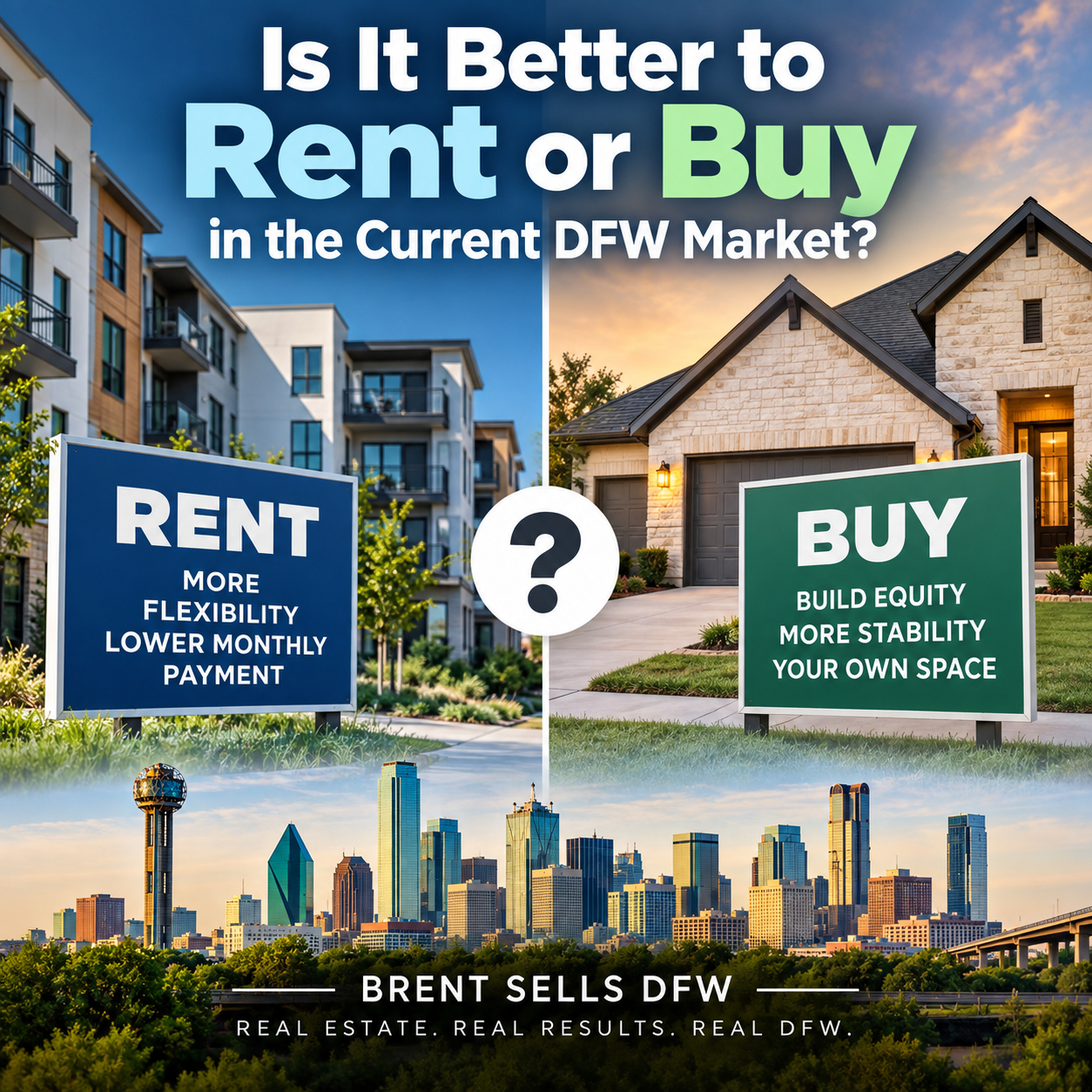
Renting is cheaper than buying in DFW right now—but that doesn’t necessarily mean renting is the better financial decision.
Short answer: Renting is generally cheaper month-to-month than buying in Dallas-Fort Worth right now. But the real question is how long you plan to stay, what buying would actually cost you, and what you would do with the money you save by renting.
What the Numbers Show
Recent Realtor.com data illustrates just how significant the rent-versus-buy gap can be.
In July 2026, the median asking rent used in Realtor.com’s DFW comparison was approximately $1,463 per month, while the estimated monthly cost of buying a starter home was approximately $2,657.
That’s a difference of approximately $1,194 per month.
However, there’s an important caveat: broad market averages don’t necessarily compare the exact same type of property. A one- or two-bedroom rental and a single-family home aren’t interchangeable.
If you’re deciding whether to rent or buy, the more useful comparison is the actual rental you would choose versus the actual home you could purchase.
DFW Renters Have Negotiating Power Too
Buyers aren’t the only ones benefiting from changing market conditions.
Realtor.com reported a DFW median asking rent of approximately $1,460 in August 2026, down 2.4% from a year earlier.
Rental concessions have also become widespread, with landlords offering incentives on a significant share of rental listings.
That means renters may have opportunities to negotiate or receive incentives too.
Why “Renting Is Cheaper” Doesn’t Settle the Question
Buying Builds Equity
Part of a mortgage payment goes toward paying down the loan and increasing your ownership stake in the property.
Rent doesn’t create home equity.
But that doesn’t mean every dollar of a mortgage payment becomes equity. Homeowners also pay interest, property taxes, insurance, maintenance, and potentially HOA fees and other expenses.
That’s why comparing rent versus the mortgage payment alone can be misleading.
Renting Gives You Flexibility
Renting can make a lot of sense if you’re uncertain about where you’ll be a few years from now.
You don’t have the same transaction costs associated with buying and later selling a home, and you’re generally less exposed to major repair expenses.
Buying Gives You More Control
Homeownership can provide more control over your living space and greater predictability than renting, particularly if you have a fixed-rate mortgage.
You’re also building an asset that may appreciate over time—although home values aren’t guaranteed to increase.
How Long Are You Planning to Stay?
This may be the most important question.
Buying comes with upfront and transaction costs. If you’re likely to move again relatively soon, there may not be enough time for potential appreciation and principal reduction to offset those costs.
If you’re planning to remain in the home for many years, the calculation changes.
Rather than relying on a universal “rent for three years, buy for five” rule, I prefer to run the numbers for the specific property.
Your purchase price, interest rate, property taxes, insurance, maintenance, down payment, closing costs, expected rent, and how long you plan to stay can dramatically change the answer.
Buyer Incentives Can Change the Math
This is particularly important in today’s DFW new-construction market.
Depending on the builder and community, buyers may find incentives such as:
- Below-market financing
- Interest-rate buydowns
- Closing-cost assistance
- Builder credits
- Upgrade incentives
Resale buyers may also be able to negotiate seller-paid closing costs, price reductions, repair credits, or other concessions.
Those incentives can materially change the rent-versus-buy calculation.
It’s Not the Same Everywhere in DFW
Dallas-Fort Worth isn’t one housing market.
Rent, home prices, property taxes, insurance costs, HOA expenses, builder incentives, and available inventory can vary substantially between Fort Worth, North Richland Hills, Keller, Arlington, Mansfield, Burleson, Denton, Weatherford, and other DFW communities.
That’s why a Metroplex-wide average should be a starting point—not the answer to your individual decision.
Bottom Line
Renting is generally cheaper month-to-month than buying in DFW right now.
There’s no reason to spin that.
But “Which costs less this month?” and “Which makes more sense for me over the next several years?” are two very different questions.
If you’re likely to move relatively soon, value flexibility, or aren’t ready for the upfront costs of homeownership, renting may make more sense.
If you’re planning to stay longer, have the financial resources to buy comfortably, and value building equity and owning your home, buying deserves a closer look—especially when seller or builder incentives are available.
The best comparison isn’t DFW rent versus DFW mortgage averages.
It’s:
The home you would actually rent versus the home you would actually buy.
Want to Know Which Makes More Sense for You?
Not sure whether renting or buying makes more sense for you? Send me your current rent, the price range you’re considering, and how long you expect to stay in DFW. I’ll help you compare the numbers side-by-side using your actual situation—no sales pitch, just the math.
Have Questions? Let's Talk.
Fill out the form below and I'll get back to you shortly. No pressure, just honest guidance.