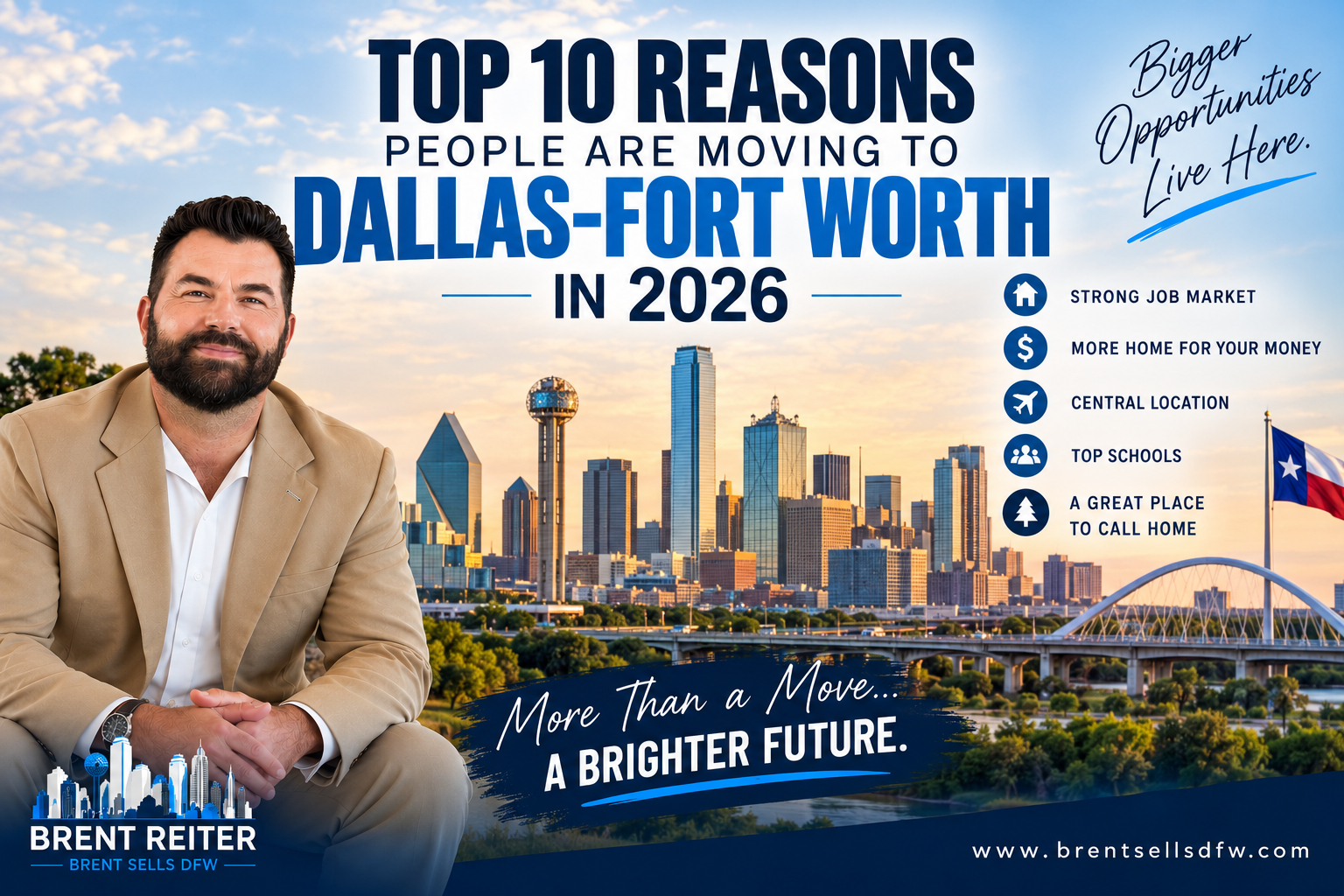
Top 10 Reasons People Are Moving to Dallas-Fort Worth in 2026
DFW isn't just growing — it's currently the top relocation destination in the country, and the reasons behind that go a lot deeper than "no state income tax" (though that helps). Here's what's actually driving the move, plus the honest trade-offs worth knowing before you pack the truck.
DFW isn't just growing — it's currently the top relocation destination in the country, and the reasons behind that go a lot deeper than "no state income tax" (though that helps). Here's what's actually driving the move, plus the honest trade-offs worth knowing before you pack the truck.
1. No State Income Tax
Texas doesn't tax personal income — full stop. For anyone relocating from California, New York, or another high-tax state, that alone can be worth tens of thousands of dollars a year. It's the headline reason, but it's far from the only one.
2. The Job Market Is Genuinely On Fire
This isn't marketing spin — DFW attracted 11 interstate or international corporate headquarters relocations in 2025 alone, the highest total of any metro in the country, according to CBRE's 2026 report. Between 2018 and 2024, the region pulled in roughly 100 corporate HQ relocations total — also more than anywhere else in the U.S. Dallas alone is now home to 21 Fortune 500 headquarters. Unemployment sits around 3.8%, and professional/business services, healthcare, logistics, and aerospace are all hiring steadily.
3. More House for Your Money
Median home prices in DFW run in the low $400,000s — a fraction of what comparable space costs in coastal metros like San Francisco, Los Angeles, or New York. Combined with no income tax, the overall cost-of-living math tends to work strongly in DFW's favor for most relocators, even accounting for higher property taxes.
4. You're Central to Everything
DFW International Airport is one of the busiest hubs in the world, putting most of the continental U.S. within a 3-hour flight. For remote workers, frequent business travelers, or anyone with family scattered across the country, that centrality is a real, everyday convenience.
5. Room to Actually Grow
Unlike built-out coastal metros, DFW still has room to expand — and it's using it. New master-planned communities are popping up on the metro's edges (we've covered towns like Cresson, where a new highway bypass just unlocked a wave of new construction), which means more inventory, more builder competition, and more options at every price point than a lot of buyers expect.
6. Top-Ranked Suburbs and Schools
Frisco, Southlake, and Allen regularly rank among the safest and best-schooled suburbs in the country. Closer to home for a lot of my clients, the Mid-Cities corridor (Hurst, North Richland Hills, Bedford, Euless, Watauga) offers strong schools and community feel without Southlake-level price tags.
7. A Genuinely Diverse Economy
DFW isn't a one-industry town, which matters a lot for job security. Fort Worth specifically anchors serious aerospace and defense employment — Lockheed Martin and Northrop Grumman both have major operations here — alongside finance, tech, healthcare, and one of the country's largest logistics and distribution hubs centered around AllianceTexas.
8. The World Just Showed Up
Dallas and Fort Worth alone drew a combined 39+ million visitors in 2024 — 27.7 million to Dallas, 11.5 million to Fort Worth — and DFW International Airport carried that momentum into 2025, handling 85.7 million passengers for the year. In summer 2026, the region hosted nine FIFA World Cup matches, including a semifinal. That's not just a fun fact — it's real evidence of the infrastructure, hospitality investment, and global attention North Texas can handle, and that legacy (stadiums, transit upgrades, international name recognition) sticks around long after the final whistle.
9. Small-Town Character Still Exists Nearby
Not everyone wants suburb-on-suburb sprawl. Towns on the metro's outer edge — Cresson, Aledo, Weatherford, Granbury — still offer genuine acreage, rural character, and a slower pace, while staying commutable to the job centers driving all this growth.
10. The Honest Trade-Offs
No relocation pitch is complete without the real talk:
- You need a car. — DFW is sprawling and car-dependent; public transit is limited outside a few urban cores.
- Property taxes run high — Roughly 2.2–2.7% to make up for the lack of income tax — factor that into your monthly budget, not just the sale price.
- Summer heat is serious — 100°F+ stretches are normal, not rare.
- Tornado season (March–June) is real — Worth knowing the difference between a Watch and a Warning before you move here.
- Traffic on I-35E, I-75, and the Dallas North Tollway — Can be brutal at rush hour, especially if your commute crosses the metro rather than staying local.
None of that tends to outweigh the upside for most people — but going in with eyes open beats being surprised.
Thinking about relocating to DFW, or already know the area you're targeting? I've put together detailed guides for dozens of North Texas cities and neighborhoods — happy to point you to the right one, or just talk through what actually fits your situation.
Brent Reiter — Brent Sells DFW
BK Real Estate
817-874-1602 | brent@brentsellsdfw.com
Serving Dallas-Fort Worth.
Have Questions? Let's Talk.
Fill out the form below and I'll get back to you shortly. No pressure, just honest guidance.